Just a year or two ago, when we spoke about a high-performing technology team, we usually measured it through familiar delivery metrics: story points completed, sprint velocity, burn down charts, release frequency, defect count, and predictability against plan.
These metrics were useful in a world where most of the delivery effort was human-led. A user story moved from requirement to design, then development, testing, release, and support. The team estimated effort, committed to a sprint, and delivery performance was judged by how closely the team stayed aligned to that plan.
But AI has changed the delivery equation.
In an AI-first development model, the effort is no longer only about “how much work does a developer need to do?” The bigger question becomes:
How clear is the requirement, and how much human judgement is still required before AI can execute safely?
That means story points need to evolve.
Story Points Are No Longer Just Effort
Traditionally, story points represented complexity, effort, and uncertainty. A 1-point story was trivial. A 5-point story had some complexity. A 13-point story was too big and needed breakdown.
That still matters, but in an AI-first delivery model, the meaning changes.
A story that looks technically small may still be hard for AI if the requirement is vague, the domain logic is unclear, or the acceptance criteria are weak. On the other hand, a technically large task may be AI-ready if the specification is crystal clear, the patterns are already established, and the expected output is well defined.
So the new interpretation of story points should include:
Specification clarity + domain complexity + human judgement required.
This is where the Fibonacci scale becomes more useful as an AI readiness signal than a pure effort estimate.
Reinterpreting Fibonacci for AI-First Delivery

In this model, low-point stories are not just “small stories”. They are AI-ready stories.
A 1 or 2-point story means the specification is clear, the pattern is known, and AI can generate most of the output with minimal review.
A 3-point story means some ambiguity exists. AI can still help, but the developer may need a few prompt iterations, review cycles, or small clarifications.
A 5-point story means the story has meaningful domain logic or architectural dependency. AI can assist, but human guidance is required.
An 8-point story means human judgement is now central. The architecture may be unclear, the business rules may be incomplete, or the solution may need design thinking before AI execution.
A 13-point story is not AI-ready. It needs a spike, discovery, or proof of concept before the team should estimate delivery.
A 21-point story should not enter development at all. It must be broken down immediately.
The Key Shift: From Velocity to Readiness
In the old model, teams often celebrated high velocity. More story points delivered meant the team was performing well.
In the AI phase, that can be misleading.
A team may deliver fewer story points but generate higher value if the stories are well prepared, AI-ready, and shipped with quality. Another team may show high velocity but spend most of its time clarifying poor requirements, rewriting AI-generated code, or fixing defects caused by vague specifications.
So the focus should move from:
How many points did we deliver?
to:
How many stories were ready enough for AI-assisted execution?
This is a major mindset change.
High-performing AI-first teams will not only measure delivery output. They will measure how well the team prepares work for AI-powered delivery.
New Baseline for High Performance Teams
To build a baseline, teams should start tracking a few simple but powerful signals:
1. AI readiness of stories
How many stories entered development with clear requirements, acceptance criteria, API contracts, data rules, and design direction?
2. Rework caused by unclear requirements
How often did AI-generated output need major rework because the specification was weak?
3. Human judgement dependency
How much architectural, product, or domain judgement was required before AI could safely produce usable output?
4. Prompt and review cycles
How many iterations were needed before the AI output became acceptable?
5. Code review depth
Was the review light validation, or did the developer need to redesign the solution?
6. Defects after AI-assisted delivery
Did AI improve speed while maintaining quality, or did it increase hidden risk?
These are better indicators of AI-first team maturity than simply measuring story points delivered.
AI Does Not Remove Engineering Discipline
One mistake teams can make is assuming AI removes the need for architecture, design, or engineering standards.
It does not.
In fact, AI increases the importance of discipline.
AI performs best when the surrounding engineering system is mature: clear requirements, reusable patterns, strong architecture guardrails, good test coverage, clean coding standards, secure pipelines, and meaningful human review.
Without that discipline, AI can generate code quickly, but not necessarily safely.
That is why the new high-performing team is not the team that simply uses AI more. It is the team that knows where AI should execute, where humans must decide, and where work must go back for clarification.
The Future KPI: Flow of AI-Ready Work
The next generation of delivery KPIs should measure the flow of AI-ready work across the lifecycle.
For example:
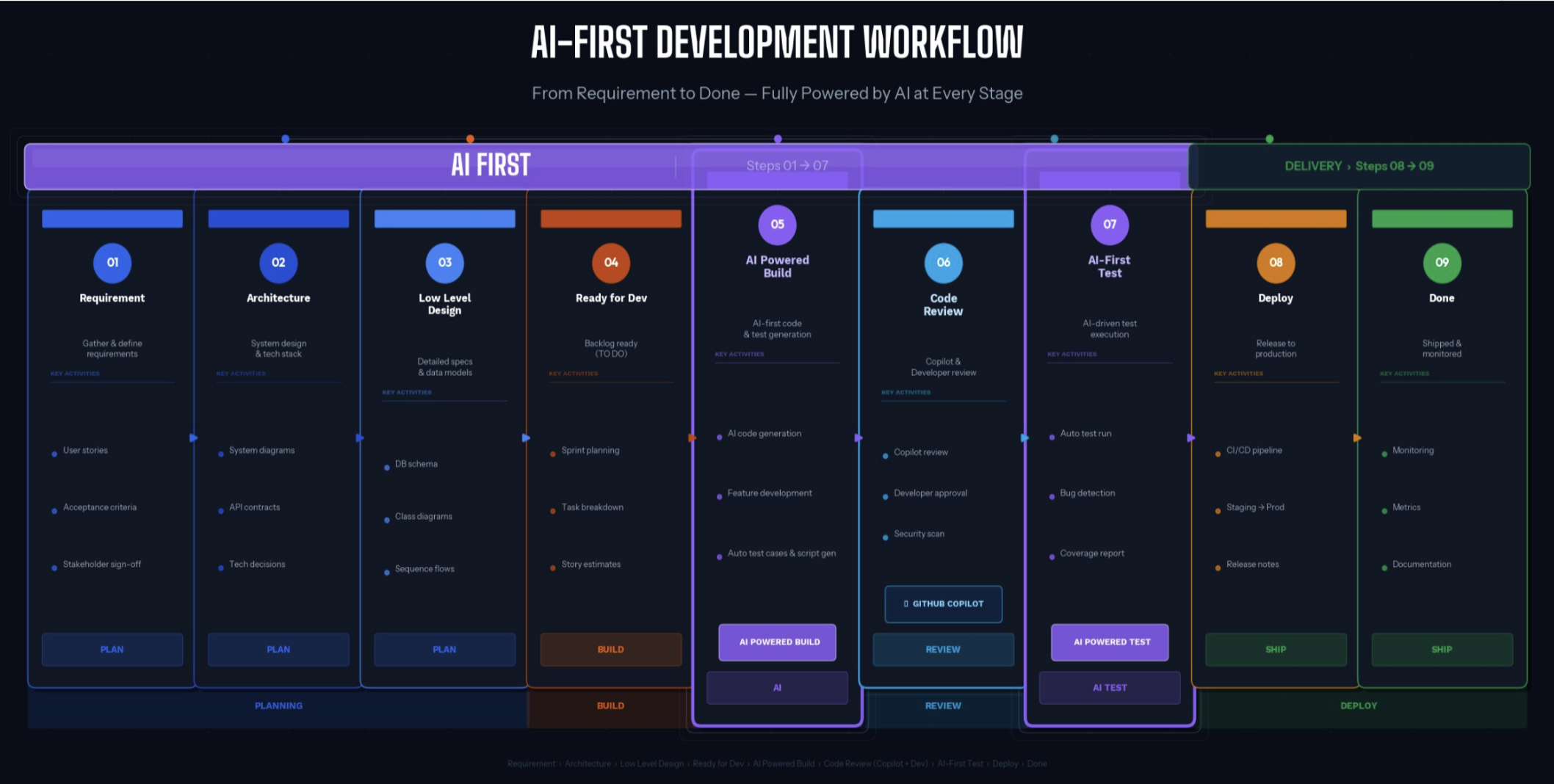
Requirement → Architecture → Low-Level Design → Ready for Dev → AI-Powered Build → Code Review → AI-First Test → Deploy → Done
The important checkpoint is not only whether a story reached “Ready for Dev”. The real question is whether it reached “Ready for AI-powered build”.
If a story reaches the AI build stage and is still unclear, too large, or dependent on unresolved human judgement, it should go back to the planning phase.
That may feel slower at first, but it avoids poor-quality acceleration.
Because in an AI-first model, speed without clarity creates waste faster.
Conclusion
The definition of a high-performing team is changing.
In the past, high performance was often measured by output: story points, velocity, burndown, and release predictability.
In the AI phase, high performance must also include readiness: clear specifications, strong design, well-defined acceptance criteria, reusable patterns, and the right balance between AI execution and human judgement.
Story points are not dead, but their meaning needs to evolve.
They should no longer be treated only as a measure of human effort. They should become a signal of AI readiness.
The teams that adapt to this shift early will move faster, reduce rework, and produce better outcomes. The teams that continue to measure AI-first delivery with old delivery metrics alone may create the illusion of productivity while increasing hidden complexity.
The real competitive advantage will belong to teams that can turn unclear ideas into AI-ready work — consistently, safely, and at scale.