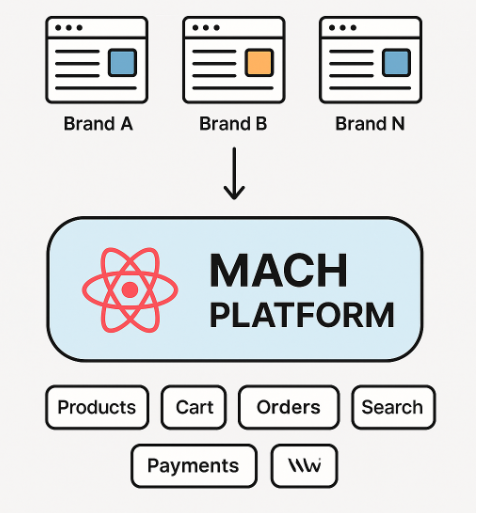
How Big Brands Run Multiple Online Stores on One Smart Platform

If you’ve ever shopped online from two different brands and felt like the experience was strangely similar — same search, same checkout, same speed . that’s not a coincidence. Behind the scenes, many companies no longer build one website at a time. Instead, they run multiple brands on one shared digital platform.
The Old Way: One Website, One Brand, One Big Mess
Traditionally, companies built:
- One website
- One backend system
- One database
- All tightly connected
This worked when a company had only one brand. But when businesses started managing:
- Multiple brands
- Multiple countries
- Multiple mobile apps
- Millions of users
Everything became:
- Slower to change
- More expensive to maintain
- Risky to upgrade
- Hard to scale
A small change for Brand A could accidentally break Brand B. That’s when modern architecture entered the scene.
The New Way: One Platform, Many Brands
Today’s leading companies use a multi-brand platform. That means:
- Each brand still looks and feels unique to customers
- But behind the scenes, they share powerful core systems
- Everything is modular, flexible, and cloud-based
Think of it like:
One strong engine running multiple different cars.
What Is MACH (In One Paragraph)?
MACH is a modern way of building digital platforms. It stands for:
- M – Microservices: Small independent backend services
- A – API-First: Everything talks through secure APIs
- C – Cloud-Native: Built for the cloud from day one
- H – Headless: Frontend and backend are separate
This allows brands to:
- Change faster
- Scale globally
- Launch features independently
- Avoid big “all-or-nothing” upgrades
What Customers Actually See
From a shopper’s point of view, it looks simple:
- You open a brand website or mobile app
- You search for products
- You add items to the cart
- You check out
- You receive payment and shipping confirmation
Behind that smooth flow, many systems are working together:
- Product catalog
- Cart
- Orders
- Payments
- Search
- Promotions
- Emails
- Shipping providers
But because they are separated into independent services, everything stays fast and reliable.
The Three Ways Companies Run Multi-Brand Systems
Let’s break this into three real-world models.
1. Fully Shared Model (Cheapest & Fastest)
In this setup:
- All brands share the same backend services
- All data lives in one big database
- Brands are separated only by a “brand ID”
Lowest cost
Easiest to maintain
⚠️ Higher risk if something goes wrong
⚠️ Strong data security rules are required
This model is common for:
- Startups
- Fast-growing digital platforms
- Marketplaces
2. Fully Isolated Model (Most Secure & Most Expensive)
Here:
- Each brand has its own backend
- Its own database
- Its own infrastructure
Maximum security
Total independence
Perfect for regulated industries
⚠️ Expensive
⚠️ Slower to roll out changes across all brands
This is common in:
- Banks
- Healthcare
- Highly regulated enterprises
3. The Hybrid Model (The Industry Favourite)
This is the best of both worlds:
- Critical systems like:
run separately for each brand
- Supporting systems like:
– Strong data protection
– Lower cost than full isolation
– Flexible future growth
– Faster innovation
Reference Architecture on AWS

#MACH #Mulitbrand #Microservice #Microfrontend